Mini Split vs Window AC Electricity Cost: Which Uses Less Power?
If you are looking at your summer electric bill and wondering whether changing that window unit for a ductless mini split will actually save you money, I've been right there with you, especially when comparing mini split vs window ac electricity cost. Here in Wilmington, NC, my cooling season runs from April well into October, and every kilowatt-hour adds up. I spent weeks pulling real numbers on both systems so I could figure out which one actually uses less electricity for a typical bedroom or bonus room. Here's what I found.
Which system wins on electricity cost?
For most homeowners running AC many hours a day through a long, humid summer, a ductless mini split uses about 30% to 40% less electricity than a similar window unit of the same BTU size. That is not marketing hype - it is what the efficiency ratings and real watt-draw numbers support once you do the math.
Let me put it in dollars. Say you are cooling a room that is 400–500 sq ft for about 1,400 hours per year (pretty realistic for Wilmington's climate) at $0.17/kWh. A mid-range 12,000 BTU window AC with a CEER around 11 might cost you about $266 per cooling season in electricity. A 20 SEER2 mini split that handles the same load comes in around $143 per season - about $123 less every year, just on the power bill. Depending on the specific models compared, mini splits can save homeowners about $155 per cooling season.
That said, this section is about electricity cost only, not upfront price or comfort features. A single-zone mini split costs $3,000 to $6,500 installed, while a window AC costs $300 to $750 installed - so the break-even point for mini splits is usually 3 to 5 years. The sections below dig into total cost of ownership, hidden losses and when a window AC might actually be the smarter call.
What is a ductless mini split (and how does it use electricity)?
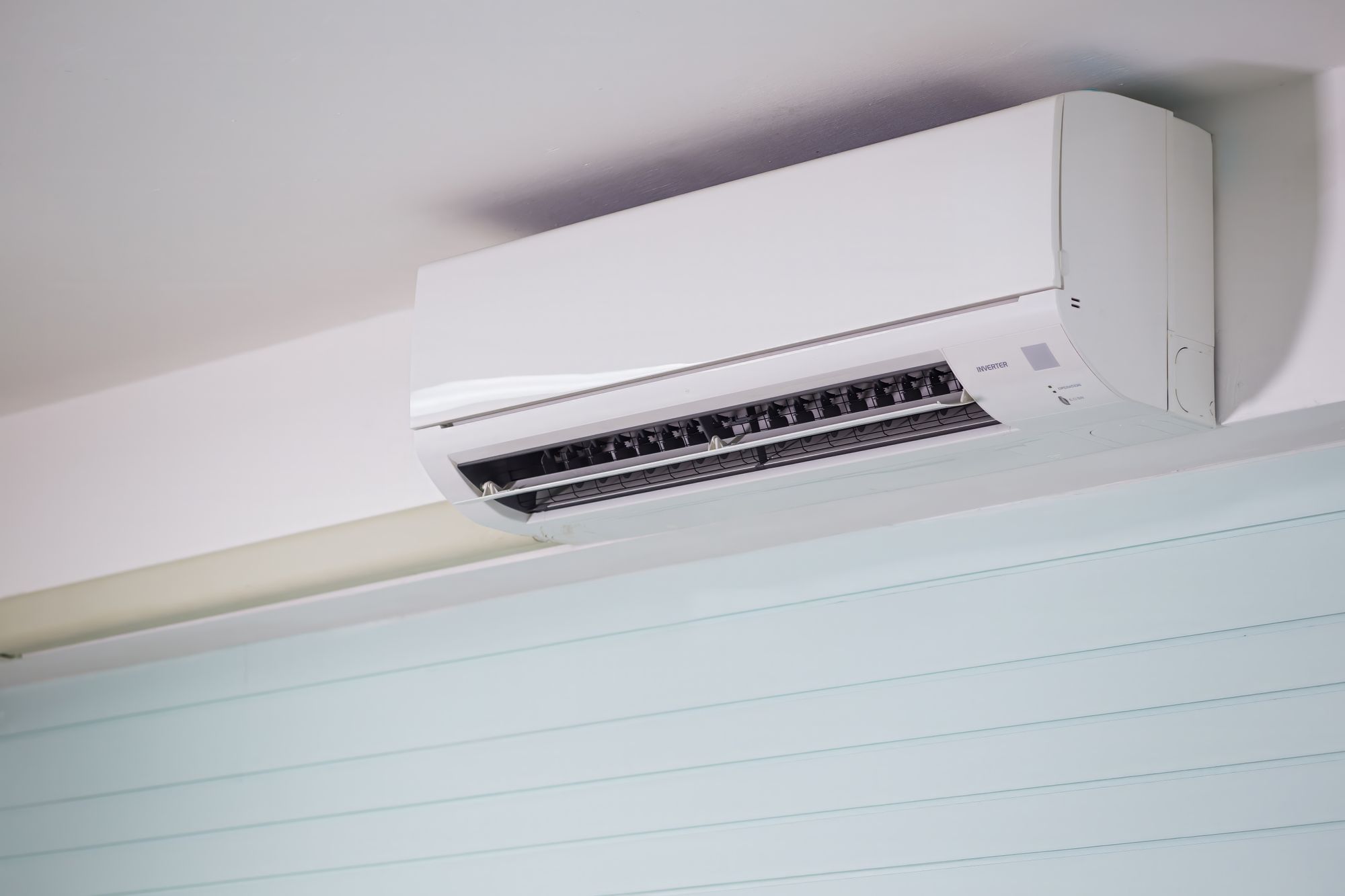
A ductless mini split is a two-piece air conditioning system: an outdoor compressor (the noisy box) connects to one or more indoor air handling units mounted on your wall via refrigerant lines that pass through a small wall penetration. No ductwork is needed - that's why they're called "ductless."
- Most modern single-zone mini splits are inverter-driven heat pump units, which means they can heat and cool. Even if you only care about cool air in summer, the heat pump design is what makes them so efficient.
- In 2026, common residential ductless mini split systems carry SEER2 ratings between 18 and 30+. The federal minimum for non-ducted split heat pumps is about 14.3 SEER2, but most units sold to homeowners go well past that.
- Inverter driven compressors can ramp up and down instead of cycling fully on and off. A 12,000 BTU mini split unit might pull around 1,200 W at full power but run at just 300–500 W once it reaches your set temperature. That change in speed is the main reason mini splits use less electricity over the course of a day.
What is a window AC (and how does it use electricity)?
A window AC is a self-contained box - it has a compressor, condenser, evaporator and fan all in one cabinet - and it sits in a window frame or wall sleeve. You plug it in, turn it on and it pushes cold air into the room while sending heat outside.
- Most budget window AC units still use fixed-speed compressors that cycle fully on and off. When the compressor kicks on, it pulls full wattage. When it shuts off, it draws almost nothing. Window units operate with fixed-speed compressors that waste energy during this cycling process because the unit goes past the set temperature, then lets it climb back up before kicking on again.
- Typical CEER ratings in 2026 run about 10–12 for cheap big-box models and 13–15 for ENERGY STAR or inverter-style window air conditioners. Best-in-class units reach about 16 CEER.
- A 10,000–12,000 BTU window AC might pull 900–1,400 W whenever the compressor is running. In a hot, humid climate, the compressor might run 60–80% of the time.
- Common real-world problems raise electricity use beyond what the label suggests: poor window sealing that lets warm air pour in around the side panels, dirty filters and coils clogged with pollen and coastal salt spray. Here in coastal North Carolina, salt air is hard on outdoor coils.
- Modern inverter window units closely bridge the efficiency gap with mini splits, but even the best inverter window ACs can't quite match the kWh-per-BTU performance of a similarly priced mini split in 2026.
Mini split vs window AC electricity cost
Here's a side-by-side comparison focused strictly on power use and monthly bills for a single room, assuming a 12,000 BTU cooling load and a full cooling season in a hot, humid climate like Wilmington.
| Factor | Ductless Mini Split | Window AC |
|---|---|---|
| Best for electricity cost | Heavy daily use, all-summer cooling, multiple rooms | Occasional or weekend-only use in one room |
| Typical efficiency rating | 20–25 SEER2 (mid-range to premium) | 10–15 CEER (budget to ENERGY STAR) |
| Typical watt draw at full output | \~1,200 W peak, but 300–900 W most of the time | \~900–1,400 W whenever compressor runs |
| Estimated kWh per season (1,400 cooling hours) | \~670–840 kWh | \~980–1,570 kWh |
| Estimated seasonal electricity cost at $0.17/kWh | \~$114–$143 | \~$167–$266 |
| Monthly operating cost range | $15 to $45 per month | $30 to $75 per month |
The biggest takeaway: over a full cooling season, the mini split typically cuts power use by 30–40% compared to a midrange window unit of the same BTU size. Mini splits use 30% to 40% less electricity than window ACs, and that gap widens the more hours you run them.
Decisive factor #1 - Efficiency ratings (SEER2 vs CEER) and what they mean on your bill
SEER2 (Seasonal Energy Efficiency Ratio 2) is the measure used for mini splits. It measures seasonal efficiency across many part-load conditions, which is a better picture of real-world use than a single peak number. For most residential models sold in 2026, mini splits have SEER ratings between 20 and 30. As a rough rule of thumb, each step up in SEER2 (say from 18 to 20) can save about 5–8% on seasonal electricity for the same cooling load.
CEER (Combined Energy Efficiency Ratio) is what you'll see on the EnergyGuide label of window air conditioners. Window ACs usually have CEER ratings between 10 and 15. Budget units group around 10–12 CEER, while the best ENERGY STAR inverter models push 15–16.
SEER2 and CEER aren't directly similar since they use different test procedures, but in both cases, higher numbers mean fewer kWh for the same cooling. Here's a quick back-of-the-napkin example:
- There is a 12,000 BTU load, 1,400 cooling hours/year, $0.17/kWh
- 22 SEER2 mini split: (12,000 × 1,400) ÷ (22 × 1,000) = 764 kWh → \~$130/season
- 12 CEER window AC (rated ~1,140 W, ~80% duty cycle): 1,140 × 0.80 × 1,400 ÷ 1,000 = ~1,277 kWh → ~$217/season
- Difference: ~$87/season, and that's comparing a solid (not top-tier) mini split to a fairly average window unit.
Decisive factor #2 - Real-world usage patterns (hours per year, climate and room size)
Heavy-use scenario: Here in Wilmington, my bedroom AC runs 12–16 hours a day from May through September, with shoulder months on top of that. At those hours, the mini split's lower per-hour watt draw adds up to serious energy savings. Operating costs for mini splits are generally lower due to high efficiency ratings, and during the hot summer months, every hour of operation widens the gap. If you are cooling multiple rooms, a multi zone system replaces several window units and puts the efficiency advantage in one place.
Light-use scenario: A guest room window AC used a couple of weekends a month might only log 100–300 hours per year. At 200 hours, the annual electricity difference between the two systems might be $15–$25 - nowhere near enough to make the higher upfront costs of a mini split worth it.
Sizing mistakes waste electricity for both systems regardless of type:
- For an average insulated room, a quick rule of thumb is to plan on about 20 BTU per square foot. South-facing bonus rooms over garages here in the Southeast - with high ceiling height and lots of solar gain - may need 25–30 BTU/sq ft.
Decisive factor #3 - Hidden efficiency losses (installation quality, infiltration and maintenance)
- Air leaks around the unit are the biggest culprit. Those thin side panels, poorly cut plywood and worn foam strips let warm air pour into the room, forcing the compressor to work harder. I've sealed plenty of window openings for storm panels, and I can tell you: fasteners for code plywood window panels must sit at least 1 inch from the panel edge and go at least 2 inches into wall framing, through the siding. The same attention to anchoring and sealing applies when you are mounting a window AC - if the area around it is not solid, you are cooling the neighborhood.
- Improvised sealing in older wood window frames is usually worse than in newer vinyl units. Unsealed gaps around the window frame effectively increase your cooling load, which means more kWh on your electric bill.
- Filters rarely get cleaned, and coils clog with dust, mold and coastal salt spray. Over a season or two, a neglected window unit's real-world CEER can drop a lot below the label number.
- A properly done mini split installation includes a professionally sealed wall penetration and evacuated refrigerant lines, which dramatically reduce air leakage compared to a half-sealed window AC. I always seal penetrations carefully - a 100% silicone window and door sealant (like GE Advanced Silicone 2) is tack-free in 30 minutes at 72°F / 50% RH but takes a full 24 hours to cure. Don't assume it's fully sealed before then.
Decisive factor #4 - Electricity cost over the system's lifetime
- Window AC units can last 8 to 12 years in average use - often less in harsh coastal climates or when moved in and out of windows every season. Many window AC units fail before 8 years. You may replace a window AC two to three times in 20 years.
Let's use our earlier seasonal numbers - a mid-range window AC at ~1,568 kWh/season ($266) versus a 20 SEER2 mini split at ~840 kWh/season ($143), both at $0.17/kWh:
- Over 10 seasons: Window AC electricity ≈ $2,660. Mini split electricity ≈ $1,430. Savings: ~$1,230.
- Over 15 seasons: Window AC electricity ≈ $3,990. Mini split electricity ≈ $2,145. Savings: ~$1,845. And that's before accounting for the fact that the window unit probably won't survive 15 seasons - you'd likely buy a replacement partway through, adding another $200–$1,000 in buy cost plus more kWh from an aging second unit.
Window AC units rarely qualify for any incentives. Mini splits often qualify for utility rebates or state incentive programs when they exceed certain SEER2/EER2 levels or hit ENERGY STAR levels. Local incentives can take hundreds off the overall cost. Those rebates can speed up the break even point.
Winner: Mini split - over a 10–15 year run, its lower kWh use usually beats the electricity costs of an equivalent window AC by a wide margin, especially as power prices rise. Window units can only keep up in truly low-use rooms where the seasonal kWh difference is tiny.
Mini split vs window AC - which should you choose for electricity cost?
- Window AC installation costs $0 to $250 depending on complexity, and window AC units cost $200 to $1,000 to buy - far less upfront cost than a mini split. If you're renting or expect to move within 1–3 years, long-term kWh savings don't matter as much.
From my perspective, comparing mini split vs window AC on electricity alone, the mini split is the better long game almost every time for heavy users. But for a single low-use room, it's perfectly okay to stick with or buy a window unit and just install and seal it as carefully as you can. Mini splits need EPA-certified professionals for installation, so factor professional installation into your decision - mini split installation costs $1,500 to $3,000 for the labor alone, and a single-zone mini split costs $3,000 to $6,500 fully installed.
FAQ about mini split vs window AC electricity cost
Will a mini split always lower my electric bill compared to my current window AC?
- If your existing window unit is a modern inverter model with a high CEER (15+) and you only run it lightly, the energy savings from switching may be small - maybe $30–$60 per season rather than $150+.
How do rising electricity rates change the mini split vs window AC decision?
- Quick example: at $0.13/kWh, a 730 kWh seasonal difference saves ~$95. At $0.20/kWh, that same 730 kWh difference saves ~$146 - it's over 50% more in dollar terms with no change in behavior.
Does using "eco" or "energy saver" mode on a window AC close the electricity gap with mini splits?
- Eco modes can reduce runtime by cycling the fan and compressor more carefully, and they do save some kWh - usually 10–15% compared to running the unit wide open.
When is it worth calling a pro vs DIY for better electricity performance?
- A poorly charged system can waste 10–20% more electricity than a properly set-up unit. To install mini splits, you should use a licensed HVAC professional. Refrigerant handling and vacuuming the lines directly affect efficiency and how long the system lasts. Mini splits need EPA-certified professionals for the installation process.
- For the electrical work side - especially if a mini split needs a dedicated 240V circuit - check your local permit requirements. In many areas, that's a licensed-electrician job even if you're comfortable with the wiring itself.