Portable AC vs Mini Split for Garage: Which Should You Choose?
If you are trying to make your garage usable in the summer with a portable ac vs mini split for garage decision - whether it is a home gym, workshop or just a place to wrench on your car without melting - you might have found two options: a portable AC or a ductless mini split. I've gone back and forth on this myself in my Wilmington, NC garage, where summer temps and coastal humidity can make an unconditioned space pretty much worthless from June through September. Here's what I've learned about how these two cooling options actually do in a real garage, and when each one makes sense.
What Is a Portable Garage AC?
Rolling around on the floor, a portable air conditioner is a self-contained cooling system that sits on the floor and vents hot air out through an exhaust hose. You usually send that hose out through a window, a side door or a panel that you cut into your garage door. Most units plug into a standard 115V outlet and say they have between 8,000 and 14,000 BTU of cooling.
Here's the catch: those BTU numbers are often too high. Portable AC units are tested under the DOE's SACC method, which is a test that looks at losses you see in the real world. A portable unit labeled "12,000 BTU" might only deliver 8,000–10,000 BTU of effective cooling once you factor in hose leakage and, with single-hose models, the negative pressure that draws hot air right back in through every crack and gap.
Garage use is very different from cooling a bedroom. You are dealing with a larger heat load - the sun hitting a thin roof, an uninsulated slab giving off stored heat, and a large garage door that is basically a wall of sheet metal. Garages can run 20°F to 30°F hotter than outside air due to insulation issues, which means your portable unit is fighting an uphill battle from the start.
- Low cost: A capable portable unit will cost you $350–$700 at most big-box stores.
- DIY-friendly: You can take it out of the box, attach the hose and plug it in. There is no change to your garage wall that lasts.
- No commitment: You can roll it into another room, lend it to a neighbor, or store it in the off-season.
- No permits or pros require: No refrigerant lines, no electrical work, no inspections.
- It takes up space on the floor and creates tripping hazards with hoses and cords. This is a real problem in a workshop with no room to move or when you're trying to park.
- Portable ACs are usually noisier than mini split systems, often hitting 54–65 dB at a few feet away - like having a loud box fan running constantly.
- Single-hose portable AC models do not work as well in large or poorly insulated garages because they exhaust conditioned air and pull hot air back in to replace it.
What Is a Ductless Garage Mini Split?
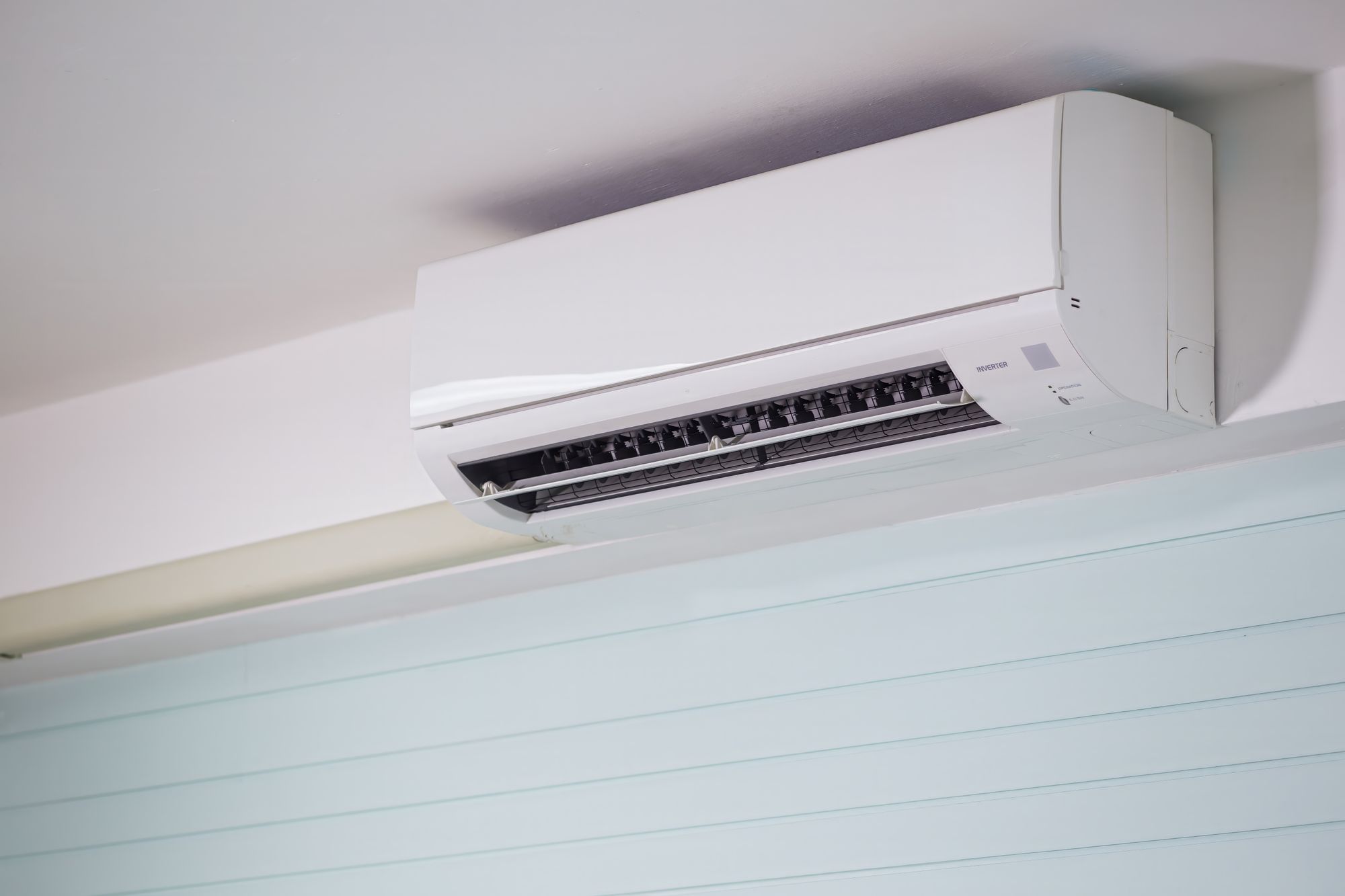
In a garage mini split setup, you have an indoor unit that mounts on the wall (the air handler) and one outdoor unit (the compressor/condenser). The two are connected by a small line set of refrigerant lines, electrical connections and a condensate drain that goes through a core hole in the garage wall. Most homeowners who want to condition a one- to two-car garage will need a single-zone system in the 9,000–24,000 BTU range.
The big difference: most mini splits for garages are heat pumps, so they provide both heating and cooling efficiently. That can matter if you want to use your garage year-round - not just in hot summers but through cold winters too. Modern cold-climate models can work effectively in temperatures down to -22°F, though here in eastern NC our winters are mild enough that any decent heat pump handles them fine.
- High energy efficiency: SEER2 ratings in the high teens to low 20s mean a lot lower energy bills for each BTU delivered. Mini splits have inverter technology for energy savings, and the compressor speeds up and slows down rather than cycling on and off.
- Quiet operation: The indoor unit usually runs at 25–35 dB on low or medium. That's quieter than a library. The outdoor compressor sits outside, so you can barely hear it while you work.
- Superior humidity control: Mini splits run longer, controlled cycles that pull much more moisture out of the air. This is critical in a humid coastal climate.
- Improved indoor air quality: Mini splits are able to improve air quality by filtering dust and allergens, and mounting the unit high on the wall keeps it away from garage-level dust and exhaust.
- Longevity: Mini splits can last over 20 years with proper maintenance, compared to the 5–8 year lifespan that is typical of portable air conditioners.
- Higher upfront cost: Installation costs for mini splits are in the $2,000 to $7,000 range, depending on the size of the garage, what you need for electrical, and labor.
- Installation complexity: Professional installation is essential for mini split systems. You need holes in the wall, mounting that is done right, a way to drain condensate, and licensed technicians for refrigerant lines and electrical connections. Installation that is done wrong can void the mini split warranty.
- Electrical requirements: A mini split requires a dedicated electrical circuit, usually 240V, which may mean running new wire from the panel and pulling a permit.
Portable AC vs Mini Split for Garage
This table is geared toward a typical one- or two-car attached garage - about 200–500 sq ft - in a hot-summer climate like the one we get along the North Carolina coast.
| Factor | Portable AC | Mini Split |
|---|---|---|
| Best for | Occasional use, renters, tight budgets | Daily or year-round use, homeowners investing in comfort |
| Upfront cost | $350–$700 for a capable unit | $2,500–$5,000+ installed (single-zone) |
| Operating cost | \~$49/month at 8 hrs/day use (\~1,100W draw) | Roughly 40–50% less electricity for same cooling output |
| Cooling: 1-car garage (\~250–300 sq ft) | One unit can take the edge off if insulated | 9,000–12,000 BTU unit handles it well |
| Cooling: 2-car garage (\~400–500 sq ft) | Struggles to cool beyond a small zone | 12,000–18,000 BTU unit conditions the full space |
| Heating ability | Cooling only (most models) or weak resistive heat | Heat pump provides efficient heating and cooling year-round |
| Noise (indoors) | 54–65 dB (compressor is right there with you) | 25–35 dB (compressor sits outside) |
| Installation | DIY: plug in, attach hose, vent through opening | Needs licensed pro for mounting, line set, refrigerant, electrical |
| Electrical needs | 115V, 15A - often uses existing outlet | Typically dedicated 240V circuit from panel |
| Durability / lifespan | 5–8 years typical | 10–20+ years with proper care |
The headline takeaway: The mini split wins on nearly every performance metric. The portable AC's only clear advantages are low cost and zero installation hassle - which matter a lot if you're renting or just dipping your toes in.
Decisive Factor #1 - Upfront Cost, Electrical Work and Installation
A solid portable unit in the 10,000–14,000 BTU range costs $400–$700 at retail. You bring it home, wheel it into position, snap the exhaust hose together, and plug it into the nearest outlet. That's it. No holes in the wall, no permits, no waiting on a contractor.
A single-zone ductless mini split installation for a garage typically runs $2,000–$5,500 installed, with the final price depending on BTU capacity, line set length and whether you need electrical work. Equipment alone runs $700–$1,500 for a 9,000–12,000 BTU system, climbing to $2,500–$3,500+ for larger or cold-climate models. On top of that, you're paying for professional installation: mounting brackets, core drilling through the garage wall, line set routing, vacuum and charge and condensate management.
Then there is the electrical side. A portable AC plugs into your existing 120V garage receptacle - simple, but with a caveat. The 2023 NEC (210.11(C)(4)) requires an attached garage to have at least one 120V, 20A branch circuit dedicated solely to garage and outdoor receptacles. North Carolina still enforces the 2020 NEC-based NC Electrical Code, so that is not yet local law here, but it is smart practice. If your garage circuit is already loaded up with a battery charger, shop vac and LED lights, adding a 1,100-watt portable AC could push you toward nuisance trips.
A mini split typically needs a dedicated 240V circuit run from your main panel, plus a disconnect box near the outdoor compressor. That's an electrician's job and usually requires a permit and inspection. Worth noting: the 2023 NEC also requires a Type 1 or Type 2 surge-protective device (at least 10 kA nominal discharge rating) on dwelling-unit services and feeders, including when the panel is replaced. If your mini split project triggers a panel upgrade, you may need to factor that in depending on which code cycle your jurisdiction follows.
Winner: Portable AC - dramatically lower upfront cost and a true DIY install with no permits. But you're trading away efficiency, longevity and long-term comfort that a mini split delivers.
Decisive Factor #2 - Cooling Power, Heating and Year-Round Use
Portable AC units create negative pressure that draws hot air back into garages - especially single-hose models. That "14,000 BTU" portable might actually deliver closer to 9,000–10,000 BTU of useful cooling once hose leakage and air infiltration eat into its output. In a two-car garage on a 95°F afternoon, most portable air conditioners cool a zone of maybe 6–8 feet around the unit while the rest of the space stays too hot to stand. Dual-hose designs reduce the negative-pressure problem but still can't match a mini split that is sized right.
- 1-car garage (~250–300 sq ft): For a 1-car garage, the recommendation is to use 9,000 to 12,000 BTUs. If the space is insulated, a single portable can take the edge off, but it won't keep the temperature steady. With a 9,000–12,000 BTU mini split, you can handle this comfortably.
- 2-car garage (~400–500 sq ft): A typical two-car garage needs 12,000 to 18,000 BTUs. Two car garages are where portable ACs really struggle - you'd need two units to last as long as what one mini split does. For a larger garage or a space with no insulation, a 24,000 BTU unit covers up to 500–550 sq ft. A garage with no insulation may need a unit with more BTUs. The typical guidance is to size up from 20 BTU per sq ft (insulated) to 30–40 BTU per sq ft (uninsulated).
Then there's heating. Mini splits can heat and cool, while portable ACs only cool. Most portable units are cooling-only. The few with "heat" mode use electric resistance. This is basically an expensive space heater. Delivering efficient ductless heating down into the 20s°F - and specialized cold-climate models go much lower - a heat pump mini split can handle it. If you are in your garage in January doing woodworking, the difference between a mini split and space heaters is night and day in both comfort and your electric bill.
Decisive Factor #3 - Efficiency, Noise and Everyday Comfort
Efficiency and noise do not sound exciting until you're standing in a 90°F garage next to a portable unit that sounds like a vacuum cleaner and watching your energy bills go up. These factors directly affect whether you'll actually enjoy using the space.
Here's a concrete example: a portable AC that draws ~1,100 watts for 8 hours a day at the national average of $0.18/kWh costs about $49/month. Thanks to its inverter compressor and higher efficiency, a mini split doing the same cooling job in the same garage might cost $25–$30/month. Over a four-month summer, that's $80–$100 in savings - and it compounds year after year. Portable ACs often need more energy to cool effectively because they are fighting infiltration losses the whole time.
Portable ACs are usually noisier than mini split systems - and it's not last. With the compressor, fan and condenser all packed into one box sitting a few feet away from you, most units hit 54–65 dB on high. That is like having a loud conversation compete with your music or podcast while you work.
Decisive Factor #4 - Space, Flexibility and How You Use the Garage
From a code standpoint, keep in mind that running a high-draw portable AC and heavy tools (table saw, air compressor) on the same 20A garage receptacle circuit can cause trips that are a pain. With a dedicated 240V circuit for a mini split, you can eliminate that problem completely.
Portable AC vs Mini Split for Garage - Which Should You Choose?
- Your budget is under $500 and you are okay with cooling just a corner, not the whole garage.
- You want a cooling system (and heating system) that will last 15–20 years without eating floor space.
FAQs About Portable AC vs Mini Split in Garages
Can You DIY Install a Garage Mini Split?
There are DIY-friendly "pre-charged" mini split kits on the market, and they've gotten better. But they still require careful mounting, line set routing through the wall, and following manufacturer instructions precisely to avoid leaks. Mini-splits generally require professional installation, unlike portable AC units - and for good reason. Mini splits need licensed technicians for refrigerant lines and electrical connections. My advice: handle the prep work yourself (layout, mounting pad, running conduit) and hire a licensed HVAC pro for the refrigerant connection and final hookup. Especially where permits and inspections are required, this protects your warranty and keeps you code-compliant.
Will a Mini Split or Portable AC Overload Your Garage Circuit?
Check the nameplate amperage on the unit and compare it to the breaker size for your garage circuit. Most portable ACs draw 9–12 amps on a 15A circuit. That is fine - until you plug in a table saw or air compressor on the same circuit and trip the breaker. Avoid running a high-draw portable AC and heavy tools at the same time on the same branch circuit. For a mini split, the dedicated 240V circuit sized to the unit gets rid of this problem completely - it's on its own breaker and doesn't compete with anything else in the garage.
Does a Garage Mini Split Increase Home Value?
From a code standpoint, a conditioned garage doesn't usually count as official "finished square footage" unless you do a full conversion that meets code. But you can absolutely notice and value a garage with a central system for heating and cooling - it signals a usable space for home gyms, shops or home offices. In a competitive market, a garage with a mini split can help your listing stand out versus identical homes with unconditioned garages.